Sunday, September 27, 2020

The Lamb Loom

 Located in the Historical Museum at 124 East Carlisle Street, are many interesting and historical item from pioneer days of Crittenden  County.  Here is the interesting history of the "Lamb Loom."


THE LAMB LOOM

Historic loom dates back to 1796.

By Miss Ruby Dean

If inanimate objects could only speak, the old Lamb loom at the Crittenden County Historical Society's Museum could tell us everything about itself we wish to know, as well as some hair-raising tales of pioneer days. One such tale might involve an Indian scalping which is suppose to have occurred near the very house which held this loom.

Since it can't speak for itself, we'll have to rely upon memory hearsay and a few sketchy notes left by J. N. Dean, which do not concern the loom itself but which do date the house that contained it.


When Era DeBoe fell heir to this loom, she always referred to it as the Lamb loom, although it came to her through her aunt, Mrs. Dora Wilson.


Era's “Aunt Dora” was the widow of Quincy Wilson, whose mother was Malinda Lamb before her marriage to Dr. Lysander Wilson. Dr. Wilson's early death brought her and her young son Quincy back to her father's home, where both of them lived the remainder of their lives. Malinda's father was James Lamb from whose home this loom came. Thus, “the Lamb Loom.”


James Lamb's father was John Lamb, who came to Crittenden County in 1796 from South Carolina. He had previously had three stints of service in the American Revolution. He built a log house just west of the famed spring of limestone water known as Sugar Grove Spring.


Later, about 1820, his son James built a log house a little father west. It was to this home, known for many years as the Quincy Wilson place, that Aunt Dora came as a bride about 1884. 


The loom, I have been told, was there at that time and had probably been there since the house was built. What pioneer family could survive without one?


Whether this loom served the family of James Lamb's father also, we do not know. But we would venture a guess that it did. John's family moved to Illinois about 1820, and could easily have left the loom. It would, indeed, have been very cumbersome to move. If such is the case, we can dump it right into the eighteenth century, which will make it nigh on to 200 years old. 


This log house from which the loom came stood on the old Quincy Wilson place, formerly the James Lamb homestead.


Now, let's use our imaginations and take a peek at some of those sturdy pioneer women who made use of this loom between the years 1796 and 1979: Comfort Bellah Lamb and her daughters, Catherine, Jenny, Elizabeth, Mary and Nancy; Polly Clark Lamb and her daughters, Malinda, Salina, Hulda and Betsy; Malinda Lamb Wilson and her daughter-in-law Dora Pickens Wilson.


By the early 1950's the old Jamb Lamb house was closed part of the year, especially in winter. So the loom was moved to the J. N. Dean store at Deanwood for safekeeping. While there, it was used by Joseph Gates Dean and Dorothy Dean Cook.

`````````````````


Friday, September 18, 2020

Sept. 18th, 2020 POW/MIA Recognition Day

 Sept. 18th. Today is POW/MIA Recognition Day.

 In their memory is this monument located on the Marion Commons lawn in Marion. 

 Also Crittenden County POW's not listed on the monument are: Degarth Hall, Thomas R. Perkins and Elba R. Walker. There may be more but these were names I had found. May their memories never be forgotten.


Wednesday, September 16, 2020

Improvements Change History

 With progress and improvements comes change and many times loss of old history. So it is with the recent improvement of the sidewalk on North Main Street. 

  The sidewalks may just be a small thing, but they were a part of our local history. The installing of the new concrete sidewalks have to do with re-placing of power lines on that side of the street.

In the early editions of The Crittenden Press there were little tidbits of information that was important at the time to the growth of Marion. Such it was with the new granite sidewalks that the new homes close to downtown was installing.


Many things make up the character of a small town.  Some things we see everyday, but in our busy lives we don't have the time to see all the interesting little things that make our town special.  

These sidewalks were being laid in the early 1900's when this section of Marion was growing and new homes were being built. 

 From articles during this time period that I have read, having these new white concrete walk ways was very important to the families.  Most of the home owners paid for their section of the walks to be constructed and it was a sign of a prosperous family. 

They thought it added much to the appearance of their home, which it indeed did.  In the photos above you can see the old sidewalk toppers and how it adds a touch of class to the owners property. 

Although this stretch of North Main Street has newly laid concrete sidewalks, the decorative topper was saved and stayed in place, so we have the old with the new, which is a really nice compromise, and the touch of class from over a hundred years ago is still there.

Tuesday, September 8, 2020

History of Union Baptist Church


This article first appeared in The Crittenden Press, January 7, 1955. The information was traced through the church minutes and from a copy of the Centennial Celebration.

History of the Union Church.

In the early 1800's, there was only one Missionary Baptist Church in all the country. This was Old Salem Baptist, The Mother Church.

In those early times, there were no railroads, steamboats or steam-mills, for steam had not, as yet, been harnessed. The settlements were few and far between. Wild beasts and Indians prowled the forests and endangered the settlers. Wagons, buggies and farm machinery had not, as yet, been introduced. The flatboat, the horse mill, the ox cart, the tan-yard, and the ripsaw were the great inventions of that conquering civilization.

Public free schools, mail routes, post offices, and newspapers, were far away luxuries of which the wondrous wise told around the cabin fireside. The astonished listeners wondered: How can these things be? But by faith in God, hope and love, man advanced in civilization.

In August 1806 members from Old Salem Church and Rev. Daniel Brown, their Pastor met at the home of Frederick Fulkerson (in 1955 this property was owned by John and Bennett Alvis), to observe the Lord's Supper. The Fulkersons were members of Old Salem Church. Their home became a branch church of Old Salem.

Records show meetings were frequently held at the Fulkersons home until 1810. Tradition tells us a small group of devout men and women went to gather in the grove on the rocks near old Fulkerson Spring, some four hundred yards from where we worship today, here the church was organized.

Services continued and in the year of 1812 we find from Spenser's "History of Kentucky Baptists," that Union Church joined the Little River Association of United Baptists in that same year. Perhaps here is the reason it was called Union Church (United Baptists) or Missionary Baptist.

In 1823 Union entertained the Little River Association. May 1826 Union Church petitioned Old Salem for Brother and Sister Swan to be their Deacon and Deaconess. In answer Salem said, "We think the request reasonable and leave it entirely with Brother and Sister Swan."

The exact date of the first Church building isn't known, but it was located in the lower section of the present Cemetery and remained there until 1839.

Salem Church and Union were closely allied from 1805 to 1835. Our first Pastor was probably William Buckley, as his name appears in the Old Church minutes. In 1836 Rev. Willis Champion appears as our next Pastor.

In 1837 our second Church building was completed, a hewn-log building, gabled, floored, and sealed with whipsawed lumber. It was located in the cemetery near the first building. The old building was torn down two years later.

James W. Mansfield served as Pastor from 1837 to 1841. In December 1841 a committee of Union Church met at Mt. Pleasant, near Berry's Ferry and received 14 members into our Church. The following year in April these and others were given letters of dismissal to organize a Church of their own.

In 1842 Rev. Joel E. Grace was the Pastor, there were 87 white people and 35 Negro slaves members of Union Church. The following are the Union Pastors from 1844 to 1866: Rev. Collin Hodge; Joel E. Grace; Willis Champion and Isaac McMurry.

In 1860 it was learned that Union Church didn't have a clear title to the Church property. Lewis Fulkerson, L. L. Ashby, Bard, Franklin and Riese made the necessary property transfers.

Isaac McMurry served as Pastor from 1866 to 1872.

The third Church building was completed in 1872. Built of brick and wood, 50 feet long, 38 feet wide and 14 feet between flour and ceiling. The brick were made near the church on the Fulkerson property. (This building was used until 1965. At that time, the present modern building was erected with a baptistery, education department, and fully equipped dining hall.)

In 1872, the same year the third building was completed, Rev. Collin Hodge accepted the pastoral care of the church and continued until February 1881. It was then the church reluctantly accepts his resignation due to failing health.

In 1883 Rev. T. C. Carter was ordained and accepted the pastoral care of the church until 1891 when Rev. E. B. Blackburn accepted the care of the church and continued four years.

In 1892 our church bell was erected in the top of a large black oak tree standing in the church yard. In later years the bell was removed from the tree and mounted on wood posts and is still remaining in excellent condition.

During the years of 1894 and 1896, Rev. G. S. Summers and Rev. R. A. LaRue were ordained in our church. Union pastors from 1896 through 1910 were: Rev. J. S. Henry, T. A. Conway, W. R. Gibbs and T. C. Carter.

Union Church Centennial Celebration was May 29, 1910. A brief history was prepared by Rev. R. A. LaRue for the celebration, and it was published in The Crittenden Press.

Our church laws in those days were very strict; people were excluded for swearing, dancing, fighting, non-attendance without cause, for attending services of other denominations when they should have been attending services at their own church.

At one time two members were questioned by a committee representing the church about their dancing. The lady admitted she had done wrong and was very sorry and asked the church to forgive her and she would never dance again.

She was forgiven and restored in full fellowship of the church. The man when questioned replied that he saw no harm in dancing and if he was ever at another dance he would dance again. He was excluded from the church roll.

The pastors of Union from 1910 to 1955 were: Rev. W. R. Gibbs; T. C. Carter, Herman, Y. E. Holland, Rev. Anderson, Barnes Maryman, M. M. Pollard, Rev. McGee and R. F. Thurman.


Tuesday, September 1, 2020

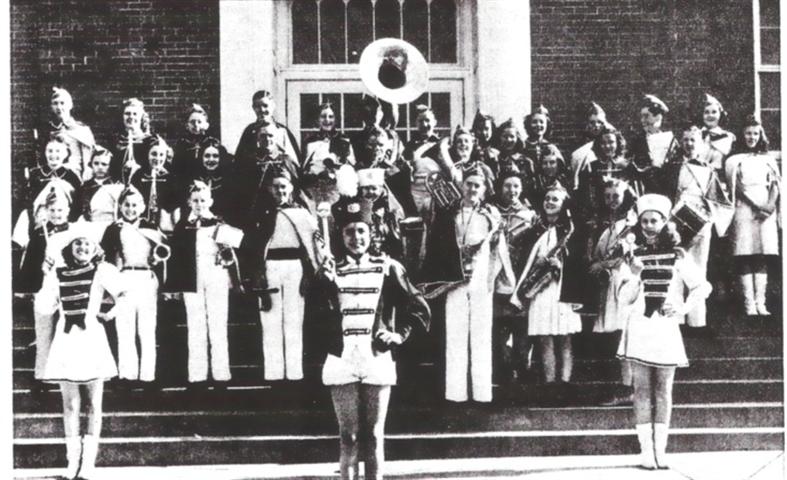
Marion High School Band Formed - 1939


April 21, 1939 – Marion High School, is after these many years, to have a High School band. At least, sounds coming from the vicinity of the new Manual Arts building on the high school campus indicate that there are some instruments of brass and some thoroughly good lungs in the community and we are taking it for granted that the ultimate aim is a band. The band is being organized by Mr. Ardwll Holmes.

May 26, 1939
Marion School Band - 36 Piece Group Under Direction of Ardell Holmes, will play concerts and make other appearances during the summer months according to announcement yesterday by Holmes.

The band is composed of 36 pieces, all members being pupils of the Marion schools. Their first appearance was Achievement Night and at that time the appearance was well received.

Members and instruments are: Clarinets: Edwin Adams, Louise Shelby, George Patmor, Eddie Bruce Nunn, Thomas Carter, Margaret Carnahan, Martha Stout, Betty McConnell, Geraldine Taylor and Margaret Helen Turner. Flutes: Marilyn Loyd and Linda Lamb. Saxophones: Jane Newcom, Christine Williamson, Harry Hale, Virginia Roe Williams, and Iris Ann Travis. Drums: Laverne Taylor, John Daughtrey, and Jesse Wayne Alvis. Cornets: Betty B. Wiggins, John T. Yates, Doyle Walker, H. C. Enoch, Jr., Buddy Loyd, Willard Moore, Bobby Swisher, and Gelima Paris. Mellophones: Jim Earl Dollins, James Wm. Mayes, and Joseph Young. Trombones: Donald Thompson, L.E. Dunning and Ralph Shelby. Baritone: Mary Helen Franklin. Bass: Dennis Clark.

The Marion School Band in their new Royal Blue and White uniforms with the jaunty over - sea's style cap.


A drive has been launched by a group of civic minded business and professional men for the purpose of purchasing caps and capes for the Marion School Band. The money is to be raised by popular donations and contributions and Neil G. Guess, cashier at Framers Bank and Trust co. has been named trustee of the fund.

Ardell Homes, director, estimates that the cost will be about $10.00 per member and there are 36 members in the organization, thus the total to be raised is set tentatively, at $360.00. No profit is to be made or derived by any individual, all funds will be used exclusively for the purpose of buying the uniforms and when purchased a competent person will be placed in charge of the uniforms when not is use.

July 28, 1939. Marion School Band to appear at Court Square Saturday afternoon. The appearance is a first of of a series planned by band director Holmes. The band has been organized for five months. During that period intensive training has been undergone. Concerts are planed on primary election day and one to be held at Fohs Hall.

Nov. 10, 1939 – Band Uniforms Are Assured For Thanksgiving.
Marion School Band will have uniforms for the annual Thanksgiving grid game against Princeton according to announcement by Ardell Holmes, director.

The uniforms will be of royal blue whipcord capes lined with white satin and the skirts or trousers of white. Members are to furnish skirts or trousers but Holmes made the restriction that these must be of white material. Details of caps had not been worked out when the uniforms were ordered late Tuesday afternoon.

The funds were aided by public donation and climaxes a drive that has been in evidence since early summer. Holmes is holding weekly practice sessions for the Tiger battle and in addition is working on drill formations. The band will make its first appearance in uniforms and also of formations Nov. 30th, the date set by officials for the Marion -Princeton battle. Holmes refused to divulge the formations he has planned but said “they will be surprising.” Drum major Charles Taylor will be flanked by majorettes Louise Franklin and Louise Shelby with “Baby Lou” Williamson as mascot.

The day of the big game finally arrived. The Marion School Band would make its first public appearance in new uniforms, which include a jaunty oversea style cap. The band will enter the field preceding the team, playing a football march. At the half, Band director Holmes, said the band will form a P in front of the Princeton stands and later an M for Marion, concluding the performance with a bell formation in mid-field and from this the Bells of St. Mary's will be played.

Wednesday, August 26, 2020

Remembering The Men who Lost Their Lives Mining Fluorspar


In the 1930’s and 40’s, Mr. Hollis C. Franklin, a noted Crittenden County businessman and community leader, and also a talented writer, wrote a weekly column in the Crittenden Press titled Two Eyes, Two Ears and A Typewriter. 

After learning of the death of a young man, Eugene Williamson, while working in the fluorspar mine in our county, Mr. Franklin wrote his column about this tragedy. From the archives of The Crittenden Press came the following story.

June 6, 1939. Eugene Williamson, 25, son of Mr. and Mrs. J. T. Williamson of Farmersville and brother of T. W. Williamson, popular superintendent of the Keystone Mines, was instantly killed about one o’clock Saturday morning, June 10, while working underground in the mine which has for the past several years been under his brother’s superintendency, and which up until this time had never had a serious accident of any kind.

Young Williamson and his buddy had been working side by side during the shift. A few minutes before the accident his buddy had gone out to get some timbers. When his buddy returned with the timber few minutes later he found the lifeless body of his friend, near the spot where he had left him only a few minutes before. It is though young Williamson had picked into a loaded dynamite hole. Those who know anything about fluorspar mining know what happens on such occasions. That one act invariably spells “tragedy” where fluorspar is mined.
Funeral services were at White Sulphur Baptist Church near Crider, where he had held church membership. 

This is Mr. Franklin’s column.
Last Friday night, a little after midnight, while most of us were in our beds sound asleep, a fine young man lost his life instantly and accidentally while working underground in one of the county’s best equipped mines. This mine, as well as most of the other fluorspar mines in this section, has always used every safety precaution. It has, too, almost constantly drilled its workmen in safety practices. Even then fluorspar mining is hazardous. It is in many ways a dangerous occupation. Life was sweet to this young man who in a little more than a month would have been twenty-five. Life was sweet to him as it is to other normal, friendly and ambitious young people. He, like most of us looked forward with pleasure to what he intended to do tomorrow, next week, next month, next year.

He was fully cognizant of the fact that his task was hazardous but man that he was, he had no hesitancy in undertaking and doing a man’s work in connection with that job. He was anxious to do his job well as other men in the same work or in other fields of endeavor are anxious to do their jobs well.

I wonder if you and I have ever stopped to think of the part which the man who works in the fluorspar mines plays in our daily life. I wonder if we have ever stopped to consider the obligation which society owes to him for the things which make for better living for us all?

Those who know tell us that spar is absolutely essential to the manufacture of more than 80 per cent of the steel used in the world today. Fluorspar is essential in the manufacture of the metal with which our homes are covered, of the nails which enable us to fashion our homes as we want them, of the cars in which we ride, of the wire with which we fence our fields of the rails on which all the trains run, of the instruments which the doctor uses in his laboratories and in his offices, of the boats which run the rivers and of the ships which sail the seas.

 In a thousand ways, fluorspar as it is mined in Crittenden County, serves in its own district way to make life more comfortable, more pleasant and happier for us all. Nothing else has ever been found that could take its place.

The men who work in fluorspar mines make from day to day a notable and noble contribution to better living for us all.
***
Note: I have compiled a list from obituaries and death certificates that total 31 men that lost their lives in mining accidents in Crittenden County from 1900-1948.  This doesn't include the Salem area mines, and I'm sure I've not been able to find all that had died in fluorspar mining accidents in Crittenden.  
***

This is a rare photo of a group of underground miners in the Big 4 Mine located near Sheridan.  They were sitting on a vein of purple and white spar.  Left to right: Orville Croft, Dewey Corn, Fred Cooper, Claude Cooper, and Taylor.

Tuesday, August 18, 2020

Tidbits about James Ford - Innocent or Guilty?


James Ford, was he really the man behind the terrible reputation that has followed him down through the ages?  or was he just used as the cover up for the murderous gang that terrorized the Cave-in-Rock and Fords Ferry area of our county?  Was he as bad as this reputation has built about him.?  After reading dozens of articles and stories about him, it leaves a question mark in my mind as who he really was.

Here is some more information about James and the Ford Gang.

James Ford and the Ford's Ferry Gang

James Ford was the chief villain in this western country in the years between the Revolution and the Civil War. Evidence suggests that many killed by Ford's confederates had booked passage on a ferry he operated on the Ohio between Kentucky and Illinois from 1823 to 1833.

Supposedly, the Kentuckian amassed a small fortune from the gold and valuables his brigands stole from settlers they murdered. Ford's hand in such nefarious activity was, however, kept well hidden. To lend respectability to his activities, Ford even served as a Livingston County magistrate and sheriff for a time (Crittenden County was formed from Livingston in 1842).

While posing as a gentleman farmer, he owned a large plantation near Tolu, KY and ferryman, Ford evidently masterminded a theft ring that was rooted at his ferry landing but had branches in the rugged country around Cave-in-Rock on the Illinois shore.

In pioneer days, that cavern, now an Illinois state park, was a haven for river pirates and other such lawless folk.

"Big Jim" Ford was shot to death on July 5, 1833, and lines buried on his family farm, just off Ky. 135, west of Tolu.  (There is another post on this blog site about the Ford Cemetery)

Ford, according to the most frequently recounted version of his demise, had bought a slave from Vincent Simpson, a member of his gang. The slave, whom Ford had been told was healthy, died in two days.

That angered Ford who sent Henry Shouse, another of his lieutenants, to kill Simpson and Shouse succeeded. But a group of men formed a posse bent on avenging Simpson's death with Ford's life. They rode to Ford's plantation at Tolu on July 5 and took him into custody. Their destination was Ford's ferry house, a double-pen log cabin that sat beside the Ohio River landing, some seven miles upstream.

During the night, Ford, was seated in the "dogtrot" or breezeway of the ferryhouse. While sitting there a slave was sent to ask Ford to eat supper with the other men, but Ford knew his escape was impossible. "No," he replied to the slave, "I guess I'll eat my supper in hell tonight." Later that night he was shot by a man concealed in underbrush close by.

A second version of his death, claims Ford was shot in the back by Simpson's son. The youth was hidden inside a cabin room of which one wall was behind Ford's chair. The chair had been placed in front of a hole in the wall. The muzzle of a shotgun was slipped through the opening and Simpson's son was given the honor of pulling the trigger. The blast stuck Ford in the back at point-blank range, killing him instantly.