Thursday, October 12, 2023

Accidential Train Deaths

 Several accidents involved with the trains of long ago occurred in our county in earlier times. From the archives of The Crittenden Press, the victim's obituaries are interesting and sad to read. They tell of the circumstances of the accidents.

***

Crittenden Press, Feb. 9, 1911 -

Minus Bradford Rushing. Resolutions of our beloved brother, a strict member of our noble order, the F. E. & C. U. of A., was struck by one of the Illinois Centrals heavy engines which crushed his skull killing him instantly.

On Dec. 25, 1910 the accident occurred. Bro. Rushing was born in Crittenden and was a good law abiding citizen, he was well liked by all that knew him. He was born January 8, 1868 and was married to Miss Alice Campbell on May 9, 1894. To the happy couple there was five children born, of this number one is dead and four are living. They lived close to the community of Mexico.

(Family information tells us that Mr. Rushing had left his home to walk to Mexico on Christmas Eve, after awhile when he didn't return home two of his children went looking for him. They found him near the railroad track where he had been hit by a train. He is buried in the Campbell Cemetery near Mexico.)

***

Crittenden Press, Nov. 1922 –

Denver Travis Killed By Train Nov. 9th. At Inquest Over Body Coroner’s Jury Find Verdict of Accidental Death.

Denver Travis, about 23 years old, was run over and instantly killed by an I. C. North bound freight train a short distance north of the Marion Depot Thursday afternoon of last week. So far as is known, no one saw the occurrence.

The body was found on the rail road track soon after the train passed, the train leaving the Marion station at 12:43 o'clock. The trainmen stated they knew nothing of the occurrence and it is thought by some that the deceased met his death by trying to board the train as it passed.

An inquest was held over the body by Judge E. J. Travis and County Attorney Edward D. Stone. The jury returning a verdict of accidental death by being run over by a railroad train.

Burial was in the James Wheeler cemetery on Just A Mere Road.

***

Crittenden Press, January 1924 –

Wyley Montgomery, 65 years old, a farmer residing near Mexico, this county, was run over and instantly killed by a south-bound passenger train about 11:20 o'clock Sunday morning Jan. 13th, between Mexico and Fredonia.

Mr. Montgomery, it is reported, was walking down the railroad tracks near Livingston Tank when the passenger train which leaves here at 11:00 rounding a curve, came up behind him and when the alarm whistle blew, instead of stepping off, started to run down the track and was struck by the engine.

Mr. Montgomery leaves a widow and four children: Ishmere Montgomery of Arkansas; Mrs. Mona Loftis, Mrs. John Tabor and James Montgomery, all of this county.

Funeral services were held at Caldwell Spring Baptist Church Tuesday, Rev. U. G. Hughes officiating. Interment at Stevenson/Stephenson cemetery on Marion Road. (He has no stone, in an unmarked grave)

***

Crittenden Press June 12, 1930 –

Guy Griffith was instantly killed Sunday, June 8th, when struck by a north bound Illinois Central freight train, at the Bellville Street crossing. The accident occurred about six-thirty in the evening.

Griffith, going to his home east of Marion, drove his car directly in front of the approaching freight in an apparent effort to beat the train to the crossing. The victim's head was crushed on one side; and the automobile entirely demolished.

In the course of the inquest testimony was introduced by G. W. Durke, engineer on the train which struck Griffith's car; by J. D. Burgess, fireman; J. W. Griffith, conductor, and T. B. McConnell, brakeman. All these men stated that the train, a through freight, was running at the speed of about twenty-five miles an hour; that the bell was ringing at the crossing, that the whistle on the train was blown; and that the pilot on the engine struck the rear side of the automobile.

Robert Murphy, of Marion, testified that Mr. Griffith stopped his car when very near the track, started it again, and when he reached the track turned toward the Marion Milling Company building.

A number of other witnesses were heard, all of whom gave the similar evidence.

The coroner jury, returned the verdict: “We, the jury, find that Guy Griffith came to his death by being struck by a freight train on the Illinois Central Railroad at the Bellville Street crossing, and that same was an unavoidable accident.”

Surviving Mr. Griffith, are eight children, his wife having died in 1922. The children are: Lois, Preston, Thomas, Matilda, Nelle, Elizabeth, George and James. A sister, Mrs. J. T. Hatcher, of Plicher, Oklahoma, and a brother, Walter Griffith, of Marion, Illinois.

The body was taken to the home of Mr. and Mrs. George Foster. Funeral services were held Wednesday with burial in the Love cemetery.

Sunday, October 1, 2023

Siloam School, Church, Residence

 An interesting article that appeared in The Crittenden Press, June 3, 1982.

Siloam Methodists Disband


The Siloam United Methodist Church building, located on Ky. 297 west of Marion, will be auctioned Saturday, June 12, by Crittenden County Reality Co. Church members gathered for their final services there Sunday, May 23, 1982.

Church trustee Bob Wilson said the decision to close the church and merge with the Tolu United Methodist Church was a traumatic one for the dwindling congregation. The church has served the community for more than 140 years.


The Siloam Methodist Church was established in the early 1800's and the first deed for the property was dated Feb. 26, 1834. The fist building was probably a log structure located about a mile lower on Deer Creek than the present one, which is the third one to house the congregation.


Besides the 1834 deed, Wilson said church papers include a Bible dedicated to the church Aug. 7, 1856, and records started in the 1850's.


According to those records, at one time more than 200 people attended services there. “It was nearly the only church in the area, with churches being “widely scattered then,”. During the early 1900s attendance dropped off as people transferred their memberships to Marion and other closer churches.


The present building, was the former Siloam School, was purchased in the 1950s. It replaced a huge weather boarded structure located a mile down the creek from the present site.


Memories of Siloam's past are good. As late as 1939, Wilson said he could remember the old building being filled with people coming from around the area.


They would come and park their wagons and buggies outside the building. If it rained, they'd bring in their buggy seats and lap rugs. There were many times people got caught by the rains and had to stay overnight in the church because they couldn't cross the creek.


Other things Wilson remembered about the old church were the wood stoves and kerosene lamps. There were two huge wood stoves on either side of the room. The preacher preached with an overcoat on many a time. It wasn't unusual for the kerosene lamps to burn down, and the preacher continued his sermon in the dark.


Wilson added that during his childhood, worship services were held only once a month although Sunday School was held every week. The church was part of a circuit then, Preaching was held there once a month with the preacher going to either Hebron, Hurricane or Tolu Methodist churches on the other Sundays.


Others memories remembered by Wilson included that at one time the church was visited by large crowds for prayer meetings. When you walked or rode your buggy up to the service, you could hear the people singing and praying. I've heard it told that during one dry season, the people gather to pray for rain. Old Uncle Jimmy Wooten rode up to the church with an umbrella in his hand. When asked what he had it for he said he aimed to use it. He got to before he left too.


Wilson said that although selling the church building may be sad for the nine active members left, it would be better than seeing it continually vandalized. He added that the church's records would be sent to the Methodist Conference archives in Louisville.

***


The historic building that once was a community school, then a church, and today it is a residence.


Picture above, made in the 1920s is when the building was the school house.


 This picture was made in 2007, a nice cared for home.

Wednesday, September 20, 2023

Lost History and Houses at the old Dam 50 site

 Our Dam 50 (now known as Riverside Park) was destroyed in Nov. 1980 because it wasn't needed anymore due to the new high lift dam at Smithland.  

A part of the closing of the dam also meant that the Corps of Engineers would be getting rid of the beautiful brick homes of the lock and dam employees.  

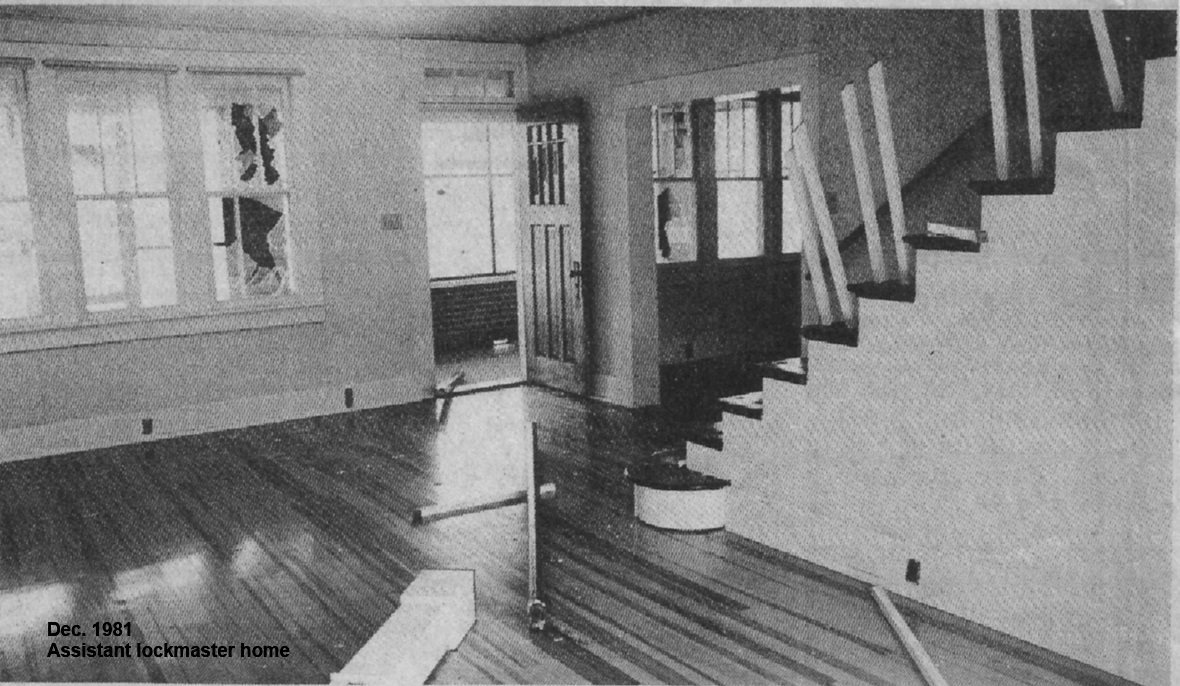
These 2-story brick homes were really pretty. Here is a picture of one of them . 

The homes would have to be torn down and removed, no one wanted to do this. 

They tried to sell them through sealed bids, but only one was even bid on and it sold for $307.00, so that left the others for the COE to tear down and remove.


In just a short time after the employees had moved from their homes vandals arrived and destroyed much of the homes insides.   Windows were broken, even the stair rails were destroyed.  This as early as Dec. 1981.


The tear downs continued until all brick and wooden structures were either torn down or the wooden ones, to the left of the picture, were removed to a different location.


The rest of the story.  In the early 1970s when the Smithland Dam project, which replaced the old wicket dam here, was being planned, the county had expressed an interest in obtaining the reservation and developing it into a park and campground.

The houses, in that early plan, would have been remodeled into vacation cottages.

Those plans fell through when Congress cut the Corps of Engineers' budget allocation for recreational projects and then county officials determined the county could not afford the long-term cost of maintenance of the property.

Tuesday, September 12, 2023

Old Fiddler's Contest of Yesteryear


MUSIC BROUGHT GOOD TIMES TO COMMUNITIES

Fiddling contest of long ago were a popular event everyone looked forward too.  It didn't matter who won, if you were lucky enough to attend one, everyone was the winner for the good times and memories to be had.

***

Feb. 5, 1926

Repton Fiddler Wins Prize In Evansville

The first prize in the final contest of the old-time fiddlers contest held in Evansville was carried off by a Crittenden County man, Isaac W. Jenkins, of Repton. The contest was held under the auspices of the Evansville Courier and a large crowd was in attendance to hear the playing of the 15 old time fiddlers, who each played some old air like "Turkey in the Straw."

Mr. Jenkins is a merchant at Repton and is 65 years old. For years he has been for the old time music he knows how to make his "fiddle" produce. The prize he won was a cash on of $20.

***

April 2, 1926

Jenkins Crittenden County Representative

Crittenden County will have a representative in the inter-state old fiddlers contest to be held in Jefferson City, Missouri, April 2. Isaac W. Jenkins, merchant at Repton has been appointed by Governor Fields to represent, with "Blind Joe" Mangrum of Paducah, the state of Kentucky in a "fiddling" contest with Missouri, Kansas, Oklahoma, Arkansas, Tennessee, Iowa, Illinois and Nebraska. The governors of the respective states have appointed two old fiddlers to take part in the contest.

The contest is being staged by radio station WOS at Jefferson City. The sixteen fiddlers from the eight states will gather at the broadcasting station in Missouri's capital city and there they will play the old time "tunes" as if before an immense audience consisting of people in all parts of the united States.

The judges in the contest are to be those who listen in on WOS Friday night. Each person who tunes in with that station may vote, the voting being done by telegraph and long distance telephone. Each telegram of long distance call will be counted as one vote for the contestant that the message favors.

People in this section are boosting for Mr. Jenkins, who is an accomplished "fiddler," and has played at different times for various occasions over the county. Only recently he won a prize in Evansville as being the best of the "fiddlers" and "foot patters." Mr. Jenkins says he is not a violin player, but a fiddler who likes to play the old time tunes.

Mr. Jenkins would like to have all his friends who own radios tune in on WOS and wire a vote for him on this Friday night. The telegraph offices are to remain open until a late hour to receive messages. (note: I don't know how Mr. Jenkins did in this contest. Mr. Jenkins died March 22, 1941 and is buried in the Repton Cemetery)

***

Feb. 8, 1928

Jonas Rushing Best Fiddler

An old fashioned fiddlers contest will be given under the auspices of the Frances P.T.A. at the Frances school house, Tuesday, February 5th. Prizes offered for the first, second and third best fiddlers, and for oldest and youngest fiddlers. There will also be a harmonica contest with prizes including those offered for the youngest and oldest harmonica players.

Participants are Jonas Rushing, Franklin Mines; Elbert Brown, Crayne; Isaac W. Jenkins, Repton, George Perkins, Frances; Elzie Frazer, Frances; Oman Matthews, Frances and others.

The winners of this old fashioned fiddlers contests were: Jonas Rushing, of Franklin Mines, who was awarded first prize and Isaac W. Jenkins of Repton, second prize. The judges were B. F. Walker, Jr., Allie Whitt and A. Hodge. Evidently no one participated in the harmonica contest.

Mexico School house was also a place for an old fiddlers contest. Winners here were 1st prize was won by Jonas Rushing, 2nd prize by Elbert Brown, 3rd prize by Jim Woodall, and the best guitar player was J. Lowry.

***

Nov. 1930 – Old Fiddlers Contest

The largest crowd ever assembled in the Shady Grove High School auditorium was present last Friday night at the Old Fiddlers Contest.

Elmo Morris was selected as the best all-around fiddler and Miss Mary Tudor as the best woman fiddler. First prize for string bands went to Traylor's band of Caldwell County and Stewart's string band of this county.

***

Nov. 20, 1936

Brewer Best Fiddler

The fiddlers' contest held at Mattoon last Friday evening was well attended and enjoyed by a large audience. Buck Brewer was declared to be the best fiddler, with F. W. Hughes a close second. Many and varied were the different types of contests beginning with sacred selections and finishing with the selection of the best of the fiddlers.

Prize winners of the various events and also entries were:

  • Best Fiddler playing some sacred selection – First, Lemand White; second, Buck Brewer; and third, Chester Yarbough. Entries were Edd Hunt, Lemand White, Wilburn Hall, Buck Brewer, F. S. Hughes, Chester Yarbrough, J. W. Jenkins and Joe Rushing.
  • Guitar selection with yodeling First, Virginia Wilson; second, Elmer Newcom, Entries: Virginia Wilson, Elmer Newcom, Frances Davis, Crawford Cowens, Wilbur Hall, Claude Cruce and Kenneth Davis.
  • Best family family band – First, Hall band, second, Newcom brothers.
  • Hawaiian guitar – First, Claude Cruce; second, Mrs. Hall.
  • Breakdown – First, F. W. Hughes; second Buck Brewer; and third, Edd Hunt. Entries: Buck Brewer, Edd Hunt, Joe Rushing, Lemand White, F. W. Hughes, Wilburn Hall, J. W. Jenkins and Chester Yarbrough.
  • French Harp – First Raymond Cain; second, Elden Harding; third, Elmer Newcow. Entries other than the prize winners: Lemand White and Crawford Cowen.
  • Best string band – First, Ragtown; second, Hughes; third, Hunts.
  • Vocal duet – First, Raymond Cain; second , Ms. Hill and son. Entries besides winners; Newcom brothers , Wilson sisters, Cruce and Cruce. , White and Newcom, and Vaughan and Vaughan.
  • Best fiddler Playing own selection – First Buck Brewer; second Chester Yarbough, third , Isaac W. Jenkins. Other entries were: Edd Hunt, Joe Rushing, Wilburn Hall, Lemand White.
  • Best fiddler of the evening – First Buck Brewer, second, F. W. Hughes.

***

Good times of long ago. May the memories live on.

Tuesday, August 22, 2023

Blackford Veterans Memorial Bridge

 The Tradewater River railroad bridge at Blackford was a vital link for the Ohio Valley Railroad that ran from Henderson, to Princeton, Kentucky.  The bridge was the heartbeat of the small community of Blackford.


 The first bridge to be constructed was a Draw Bridge.  It was shortly after 1886 when the Draw Bridge was constructed.

At that time the Tradewater River was also a vital river route for small steam-boats traveling from the Ohio River at Sturgis, up the Tradewater to the little community of Fishtrap.

The hand cut stone piers of this original draw bridge are still in place today underneath the newly renovated railroad bridge.


In 1892 the "Ohio Valley Railroad" sold the railroad line to the "Illinois Central Railroad."

In 1914 a new 528 long bridge was build by the Illinois Central Railroad with help from the U. S. Government that included a pedestrian walk bridge.  The Illinois Central Railroad design was an upgrade in structure.  The IC wanted to run larger and heavier classes of locomotives to pull coal trains from Union and Webster counties to the Illinois Central Kentucky division's main line at Princeton, KY.  

The residents of Blackford in Webter County and the people of Crittenden County just on the west side of the river always wanted a bridge to carry wagons, and buggies across the Tradewater River.  Many of the people on the Crittenden County side carried on their business in Blackford because it was much closer than Marion.  Blackford was only a little over a mile from the excellent road of Hwy 60 in Crittenden County which lead to Marion.  Getting to Marion required the people of Blackford to travel 20 miles out of their way, which could take as many as three days.


The railroad rails were removed in 1999, the wooden bridge fell in to disrepair and was closed from use.  


Through the efforts of Mr. Brent Witherspoon and the support of many people a new walking and one lane automobile bridge is in in place.  It was built using the pier structures of the 1886 Ohio Valley Railroad bridge and the concrete piers and trestle timbers of the 1914 Illinois Central Railroad bridge.  (2005). Had some problems and closed again in 2009, but reinforced and reopened in 2014. 


Both these fine gentleman are gone now.   Their work and love for the area will be remembered.


Monday, August 14, 2023

Beer in Crittenden County in 1933


Prohibition in the United States was a nationwide constitutional ban on the production, importation, transportation, and sale of alcoholic beverages from 1920 to 1933. Prohibitionists first attempted to end the trade in alcoholic beverages during the 19th century.

The 18th Amendment to the U.S. Constitution–which banned the manufacture, transportation and sale of intoxicating liquors–ushered in a period in American history known as Prohibition. Prohibition was ratified by the states on January 16, 1919 and officially went into effect on January 17, 1920, with the passage of the Volstead Act.

Despite the new legislation, Prohibition was difficult to enforce. The increase of the illegal production and sale of liquor (known as “bootlegging”), the proliferation of speakeasies (illegal drinking spots) and the accompanying rise in gang violence and other crimes led to waning support for Prohibition by the end of the 1920s.

In early 1933, Congress adopted a resolution proposing a 21st Amendment to the Constitution that would repeal the 18th. The 21st Amendment was ratified on December 5, 1933, ending Prohibition.

***

Sale of Beer Becomes Legal

WASHINGTON, March 13, 1933 (UP) - President Roosevelt in a surprise move sent a message today to Congress calling for immediate modification of the Volstead act to permit the manufacture and sale of beer. The message follows:

"I recommend to the Congress the passage of legislation for the immediate modification of the Volstead act, in order to legalize the manufacture and sale of beer and other beverages of such alcoholic content as is permissible under the Constitution; and to provide through the manufacture and sale, by substantial taxes, a proper and much needed revenue for the government.

***

Beer In Kentucky

In the March 24, 1933 edition of the Crittenden Press. Beer will be sold in Kentucky its sale was passed by the House on the night of April 6, 1933. A federal tax of $5 per barrel of thirty-one gallons will be received by the government. Thirteen other states besides Kentucky may sell beer within fifteen days from the time the beer bill was signed.

Crittenden Press, April 7, 1933, One License to sell beer here. Only one license to retail beer has been issued in Marion and that to Orme Drug Company Incorporated. While some others are expected, the number will not be large, due to the city, state and federal taxes. Orme Drug Company expects to have beer for sale Friday. It will be trucked here from Louisville. Whether the supply will be equal to the demand is a matter of conjecture.


From the old book titled Taxes Received 1926-1937 in the basement of the Crittenden County Clerk's Office these names were recorded for selling retail beer. They were owners of local eating places in Marion and on the outskirts of town. From 1933 to 1936, when the vote was was again to go dry. Orme Drug Company, Sullenger & Love, Gladys Cantrell,The Snappy Tavern, Givens Cafe, J. W. Rankin, The Curve In Restaurant, Homer J. Hughes, W. H. Crider, City Cafe, Stanley Hunt, E. B. Hunt, Velda Stubblefield – restaurant, Ray Johnson and Carlon Howard. (don't have names of all the locations that applied for beer license or sold it)

***

No More Beer

The sale of beer locally didn't set well with many citizens of the town and county, in July 1936 a petition had been filed for election on local option to go dry. Crittenden Press, July 17, 1936. The prohibition forces of the county have been busy during the past few days circulating a petition for the purpose of calling an election to decide whether intoxication liquors will legally be sold within its boundary.

The petition, containing the names and post office addresses of 1,967 legal voters of Crittenden County is now on file in the County Judge's office. The date of the election has been set for Sat. Sept. 19, 1936, and will be held in all voting precincts in the county, and is held for the purpose of giving the voters the opportunity of deciding whether the sale of intoxicating liquors shall be prohibited.

***

They Didn't Give Up

This election of Sept 19, 1936 was for local option by a vote of 1,705 as compared to 398 in favor of wines, liquor and beer. The totals surprised the most ardent drys as several leaders had previously expressed themselves as confident of victory, but not to the extent to which the final returns showed.

But this election was declared void by the Court of Appeals due to not being sufficiently advertised in advance. So in November the local Option Petition was being re-circulated among the voters to have another election for the vote.

***

Crittenden Votes Dry

In February 1937 – Crittenden county voters favored local option by a vote of 1,295 to 297 in Saturday's balloting with the counting and final tabulation being completed early that night.

The driest precinct in the county, according to returns is that of Crayne where the cause of prohibition was victorious by approximately 15-1. 73 voters favored local option as compared to 5 who did not.

Of the 22 precincts in the county Blooming Rose was the only one that returned a majority opposed to the dry cause, the vote there being 17-10 and according to statics that is the first time in the history of the county when this has happened. The heaviest vote was in Marion No. 1 and in Fishtrap, No. 20, both precincts supporting the drys by votes of 117-32 and 13-3 respectively.

***

Whiskey Traffic Only Got Worse

During the years of 1937-1939 after the county had voted dry, the sale of illegal alcohol beverages only got worse. In July 1939 a recommendation was written by the Grand Jury and given to Judge E. Jeffery Travis. It read “We the Grand Jury presiding at the last term of Court, 1939, by a careful investigation find the violation of the whiskey traffic is exceedingly deplorable in Crittenden county, particularly in and about Marion, Mexico, Dycusburg and Sheridan, and that those engaged in selling and buying are so completely organized that it is very difficult to find sufficient evidence to indict.

***

What Needs To Be Done

Judge Travis states that doubtless the members of the grand jury felt that they were rendering the county's service and helping the county officers to rid the county of the boot-legging menace by adopting this resolution. I shall take this opportunity to suggest that if each member of the grand jury, or any other law abiding, peace-loving citizen of the county would constitute himself into a committee of one and do any reasonable amount of investigating of suspicious characters in his individual neighborhood, there would be no need for an “undercover man” or detective.

Since January 3rd, 1948, the records show there have been twenty convictions for selling and possessing illegal whiskey with a total of 630 days in jail and fines amounting to $600.00. The situation is deplorable but only recommendations, orders, criticisms or anything short of sworn testimony does not “hit the spot.” There must be sworn testimony before a judge can issue a warrant of arrest.

So if you want illicit stills, boot-leggers, drunks, crap-shooters, or other semi-outlaws in your community just keep still and swear to nothing. If you want to be rid of such undesirable citizens go before a magistrate, notary public or any judge with a right to administer an oath, and make such statements under oaths and I am sure a warrant of arrest will be issued and the culprit be tried according to law. Are you willing to help? Signed E. Jeffrey Travis, County Judge

***

For one reason or the other, I don't think there were many that were willing to swear out a warrant for these bootleggers, not many would want to be known as an informer. Who really knows if it was for the money or for the thrill of doing something illegal and not getting caught, but boot-legging went on in the county for many more years. They were located all over the county.

Tuesday, August 1, 2023

Court House Business - January 1895.

 A Look Back at 19th Century County Officials

The Kentucky Constitution of 1850 provided for a county court, made up of a county judge and two associates, to conduct the business of the county and it also established a court of claims in each county, comprised of the county judge and justices of the peace.

Several years later, in 1890, our present day governing body was formed by the court of claims being abolished and the county governing body was then titled the fiscal court with the justices of the peace serving as magistrates with a county judge presiding over the court.

Fortunate once again for the archives of The Crittenden Press, and the industrious Press reporter, we can meet these early leading men of Crittenden County and even learn a little about their lives in helping forming our county. The reporter that wrote these early articles definitely had a way with words for his articles were always informative and amusing.

***

The New Deal – Court House Matters

January 10, 1895. Monday was a busy day about the courthouse. It was the day for the new officers to take charge of the ship of the county and start her out for another year.


The first officer to take a fresh start was the present popular and efficient Sheriff John T. Franks. He appeared in the county clerk's office early in the day and filed a new bond, with Albert J. Pickens, Joel W. Guess, Harry A. Haynes and Wm. J. Deboe as sureties. (picture of Franks on left)

Justices of the peace came in from their respective bailiwicks at different hours, and one by one presented themselves and their bonds at the county clerk's office and were duly inducted into office by the affable man at the helm.


First came the tall hickory for Livingston Creek, John W. Mabry, and with Messrs, J. E. and J. B. Stephenson and Eld. Wm. R. Gibbs as sureties. He was made a justice and given the power to solemnize the rites of matrimony. His regular count will be held on the second Thursday of March, June, September and December and the residents of the Dycusburg district may expect an eanest, faithful discharge of duty.

***

Next came W. E. Conditt, who physically might be called the Zaccheus of the Fords Ferry district. He is a squire, safe, sound, energetic man and those who commit in fractions upon the law, when taken before him, will get justice just as speedily, amply and firmly as if Squire Conditt was as tall as the Dycusburg hickory.

He has the right to solemnize the rite of matrimony, and will attend to business of this kind as soon as he can commit to memory an appropriate ceremony. His regular house of court will be held the fourth Tuesday of the months herein before mentioned. His bondsman is Zacy Terry.

***

Next came Pleasant C. Moore of Hurricane. His bondsmen are B. Marble, J. W. McConnell, G. D. Wathen, T. J. Hamilton and A. J. Bebout. He will wear the honors gracefully but eschews any intention of typing connubial knots. He is a clever man and will do his duty. His courts will be held the third Fridays.

***

Next came the red elm from Claylick, Thomas A. Harpending. He is an old hand at the business and in thoroughly conversant with county affairs and statutory law. Henry Brouster, who is reading law under the tutorship of the squire, is the bondsman. Harpending is the nestor of the entire board. He is a good man and will continue to do good service. He ties connubial knots to order.

***

After this the heavy weight from Butler Creek, Job Postletwaite, with Peter Shewmaker, and Billy Crow backing him, came in, and put on the toga of office. Job will keep Critenden Number 1 in order and do the right thing.  He is a plain, honest, sensible man, and nothing can swerve him from duty. He will hold court on the first Friday of the before named months.

***

George F. Williams will do the magisterial honors for Piney. His bondsmen are Robert H. Kemp, J. A. Kemp, and Phillip H. Deboe. He has been a squire and a good one too, for the past two years.  He is the most cheerful member of the board and can laugh at a fellow while he fines him for any depredation. He has too much other business to fool away time in typing people together for life.

***

The first to be sworn in was John N. Culley and he is the handsomest of the lot. He lives nears the sparkling water of the classic Tradewater, in the Bells Mines community, and has drawn from nature's store house that which makes vigorous manhood.

His bondsmen are E. M. Lindle, Finis L. Black and Thomas J. Black. The office is no new thing to him and justice need fear no harm while in his keeping. His court days are the fourth Wednesdays of the magisterial months. His office is open at all hours for hearts and hands that want to be united in matrimony.

***

The New Jailer, Mr. Ayers Hard, took charge of an empty jail. The two men who guarantee that he will do all things according to law are John J. Bennett and John W. Mabry. His first work was putting the court room in shape for the board of tax supervisors.

He was as gay as a lark all day long and went in early at night. Very soon he is going to post a notice at the courthouse gate, warning the cows and hogs (the four-footed ones) to keep off the grass.

***

Newt J. Perrigan became coroner, and his bondsmen are S. F. Snider, George W. Corn, A. F. Franklin and J. H. Curnel.  Newt is little, but he is clever, and will perform all the functions of his office as promptly as could be desired.

***


W. C. M. “Monroe” Travis,
the new county attorney, is the only county officer who is not required to give bond; he was sworn in Monday. He will move to town, from the Bells Mines community, in the course of a few weeks. Physically he is not a titan, but mentally he sizes up above average.

While he will earn bread by prosecuting the evil doer in the weekdays, he will on Sunday urge the wicked to forsake his ways and give the courts less work to do as he is also a Cumberland Presbyterian minister. (County Attorney Travis only got to fill his position for a few months, he passed away on August 30th of that same year, 1895. He was my great grandfather.)

***


John F. Flanary
, the new assessor, has long since been photographed upon the minds of the people of Crittenden County. His bondsmen are Wm. J. LaRue and Wm. H. Mayes.

He is not the largest man in the county nor the smallest, but he is a capital fellow and is going to make a good officer.

***


County Clerk Dave Woods arranged to do business at the old stand for three years more. His bondsmen are Henry K. Woods and Robert W. Wilson. Dave has grown old in the service, and by the time he retires he will probably have worn his right arm away writing and will be entitled to a pension from the fiscal court.

***


County Judge James A. Moore was re-consecrated with Circuit Clerk Haynes officiating as high priest. His bondsmen are Joel W. Guess, Garland Carter, B. W. Belt and Wm. Bennett Yandell.

He seems to be a part and pinrell of the courthouse and along with Dave Woods had as well be installed permanently. He is a good official, pleasant and patient.