Monday, June 27, 2022

Marion Bottling Company

 Once Marion was the home of a real bottling company.  Not much history is known about it, such as when it officially opened or closed.  There may have been more than one such business, but this is the only one there has been any information.

In an Oct. 1926 edition of The Crittenden Press, there was a long listing of businesses in Marion, a very impressive list to be sure, one of the businesses was the "Marion Bottling Works".  It stated W. C. Byarley is manager of the Marion Bottling Works, a business which he carries on in his establishment on South Marin Street.  Mr. Byarley manufactures and bottles the "Hip-Hy" drinks.

From the late Crittenden County historian, Thomas Tucker, came the information that this place was located where the Marion Machine Works building was, now Riley's Tool Company.  And that the drink Hip-Hy was a fruit-like drink, such as the old orange and lemon sodas.

Other establishments located in this area in previous years were the old tanyard, and then the Marion Distillery.  All places needing a plentiful source of water.  There was a ever-flowing spring that ran through this property that supplied the water for these businesses in those year.

These priceless bottles from the old Marion Bottling Works are on display in the Crittenden County Historical Museum at 124 East Bellville St.  A picture of Mr. and Mrs. Byarley or Byarly was donated also. 


Tuesday, June 21, 2022

Happings in 1912 - 110 Years Ago.


January 1912 – Marion in Winter's Icy Grip

Not for many years has such frigid weather been felt in this vicinity a that which swooped down on us last Saturday and continued on until now. The snow flew furious all day Saturday and attained a dept of 8 inches on the level and with the thermometer down to 18 below there was great suffering. Sunday some of the churches had no Sunday School or church services as the building could not be heated comfortably. Monday school was dismissed as the buildings were not heated sufficiently to prevent sickness.

County court day Monday the 8th, witnessed the smallest crowd seen here on a similar occasion for many years.

***

Jan. 11, 1912 – Ollie James Is Elected Senator

Frankfort, Kentucky, Jan. 9, 1912.At noon today both houses of the General Assembly voting separately, most in their separate chamber, elected Congressman Ollie M. James of the First District, as a member of the United Senate to replace Thomas H. Paynter. 

 His Future Gilded. Ollie M. James, of Kentucky, is one man whose future appears gilded with most splendid possibilities. In appearance he is most fortunate. Some six feet six or seven inches in height, he is erect, well proportioned and commanding. His voice is that of an orator. He is only 40 years of age. In habits he is studious and persistent.


Several terms in congress have shown him gifted with admirable qualities of leadership. Never dictatorial, never harsh, he has a host of devoted friends who love him for his heart qualities as they respect him for his head qualities.

***

Jan. 11, 1912 – A Popular Official

George M. Crider, who for 11 years has dispensed the mail at Marion post office surrendered same to his successor last week. Mr. Crider had been considered almost a stability as his first appointment dates back to the days of the lamented McKinley. When Mr. Crider was first given this office in 1897, it was not a Presidential one, but the year following in 1898, it became one, and he was at once re-appointed by President McKinley.


 President Roosevelt re-appointed him in 1902 and again in 1906, the term of which later

appointment expired last fall, since which time various rumors have been afloat as to who would be his successor, and the one most generally believed was that eventually he would be reappointed.

Marion has had many postmasters but none who has ever served so long.  Back in the seventies Warner Wagar, later Dav Stinson, Robert Coffield, Bob Walker, A. M. Hearin, and then George M. Crider; but n one more popular or beloved that the last named.  Mr. Carl Henderson will be the new Marion postmaster beginning this month.

                   ******

Silver Discovered Near Mexico

The Pigmy Mining Co., of Louisville have struck silver on their property near Mexico in the southern part of this county. This company bought the W. B. Myers property and have been operating it since early in the spring, and have been getting a fine quality of Spar rich in lead and containing silver ore.

The company work a large crew of hands and have every facility for mining on a large scale. Their mine is located on the I. C. railroad and they are putting in a branch and will load their ore on the cars direct from the mine. They have built a large washer to wash their gravel spar and will soon begin the erection of a crusher to separate the different minerals.

This is supposed to be the same vein of silver that was worked before the Civil War, when a lot of it was made into money.

                                               ****

Big Tobacco Meeting Here.

Henderson speakers deliver addresses to Crittenden Growers. One of the biggest and most enthusiastic meetings of tobacco growers ever held in the county was held Saturday afternoon. The speakers told the growers that unless the tobacco pool holds this year tobacco buyers will lower the price of the weed. The meeting was largely attended and was presided over by Judge John W. Blue, Jr.

                                     *****

Great Activity In All Mining Enterprises In this Field

The fluor spar, lead and zinc mining interests in and around Marion are in a stronger position today than ever before. In other words, the effervescing frothy period has been passed. Legitimate business methods combined with intelligence in mining have taken the place of the earlier days with all of their absurdities of statements regarding this section of the state and its mineral resources.


Fluor spar, zinc and lead mining in western Kentucky is not a poor mans game, the mining of ores and mineral here not only requires patience and pluck but a good strong bank account. Given these requisites, the returns are as sure as in any industrial enterprise known in this country.


The past few years have proven that in the counties of Crittenden and Livingston great veins of these ores and mineral exist. It has also been proven that with proper facilities as regards mining and preparing the ore for market the demand is constant and the money returns are large enough to declare superb dividends.


The demand for fluorspar is a constantly growing one, many new uses are being found for this wonderful mineral and from a few hundred tons per annum thirty years ago the consumption in 1912 will be in excess of 125,000 tons.


Mexico, Ky., eight miles south of Marion on the Illinois Central railroad shipped in 1911 according to the railroad agents statement 252 car loads of fluorspar, aggregating some 10,000 tons while from Marion an equal tonnage was probably made but largely of the ground product which brings the highest price on account of its purity.


Monday, June 13, 2022

Walker Brothers In The Civil War

 Once again you never know when you will find something new and interesting about Crittenden County people.  


In the Sisco Chapel Cemetery there is a tombstone for  Lewis Walker and his wife, Mary J. Walker. 

 I knew he was a Civil War Veteran from some earlier research.  

He joined the Union forces and was in Co. A., 48th Regiment, Kentucky Vol. Mounted Infantry.

That's all I knew.

Recently I was shared the information that there was a small booklet printed about the Walker Brothers and their history in the Civil War.  It is titled Sam Houston & Napoleon Bonaparte Meet On The Civil War Battlefield.  A True Story Of The Walker Brothers, researched and written by Edward Leo Semler, Jr.

What a surprise, Sam Houston & Napoleon Bonaparte Walker were brothers of Lewis.  


Sam and Napoleon, as the title suggests, fought on opposite sides of the war.  


 So the story was more about them than Lewis, but still Lewis is in the book, plus pictures of all three brothers, and a little history about their earlier days and how they left their home in Tennessee and two of the brothers went to Missouri and Lewis settled in Crittenden County near the Sisco Chapel area.


They all survived the war, and Lewis came back home to Crittenden County and continued with his life of farming and raising a large family.


So now this tombstone in the little Sisco Chapel Cemetery has a story to tell and a history of it's own.


The very interesting little booklet can be purchased from Amazon.com. "Sam Houston & Napoleon Bonaparte Meet On The Civil War Battlefield.  A True Story of The Walker Brothers."   What a treasure for anyone descended from this Walker line.

Saturday, June 4, 2022

A. H. Cardin Farm Destroyed by the Nightriders in 1908


During the early 1900's, one of Crittenden County's best-known residents, Albert H. Cardin, had perhaps the most immaculate and innovative farming operation in this part of Western Kentucky. Mr. Cardin was a nominee for the Governor of the state on the People's Party ticket. Although he didn't win, he made a strong showing which showed his strength and popularity as a citizen. 


Cardin's large farm was located in the rural community of View, which was about 5 miles south of the county seat of Marion. When a post office was to be establish in the area in 1886, Mr. Cardin was asked to provide a name for the area. His wife, Mary, gave the name of View, as she thought that the area had the most beautiful view of anywhere around. From the location of their comfortable home located on a small knoll one could see for miles around, and indeed, it was a beautiful view. 


The farm was known as Gum Grove. It was a beautiful farm of twelve hundred acres, by nature adapted to stock raising and every improvement in the way of building and fencing had been made that would add to its utility, so that it was considered one of the finest farms in the county. 


Mr. Cardin conducted his farming and stock raising on scientific principles, and it was of more value to the country than one first realized. His farm was stocked with the best blooded stock. His cattle were of the Jersey and Herford strain, a fine breed of both, and each of his herd was recorded. All the animals purchased by him were known to be pedigreed and descendants from a good herd. 


Cardin also raised horses and with the innate love every Kentuckian has for the fine horse, Cardin devoted a great deal of time, as well as money to the improvement of his herd. He had bought from Woodford County some of old Lexington's colts, these proved to be fine brood mares, and from these sprang the splendid roadsters and saddlers that could be seen grazing on the grassy acres of Gum Grove. 


The residence of the Cardin family was a handsome home with its beautiful surroundings, large shade tress, a good bearing orchard and all kind of small fruit. There were large lawns, wagon and machinery sheds, tobacco warehouses and houses for his tenants that farmed the land and prepared the tobacco for shipment. The land was fertile and yielded abundant crops of wheat and tobacco, and to the grasses, Cardin gave a lot of attention, knowing their importance to having good pastures for his cattle and horses.


Besides having a thriving and prosperous farm with his own tobacco factory and sheds, Cardin also owned a large tobacco house in Marion. Here he bought, packed and shipped by far the greater part of the tobacco that was sold from this area. He also sold to large dealers in foreign countries. He employed over one hundred people all year round, and this in itself was an object of importance to a small town the size of Marion.


During the year 1906 trouble was brewing among the tobacco men of the state, especially in the Black Patch area around Hopkinsville. The Tobacco Night Riders were organized in 1906. Their purpose was to force all tobacco growers to join the association and to force independent dealers to co-operate with the association and to force the trust companies to buy tobacco only from the association at its set prices. 


On the night of February 9th, 1908, approximately 150 men masked and heavily armed men rode the country road from Fredonia, Ky to the A. H. Cardin farm. They knew Cardin was an independent tobacco dealer and at one time was temporary chairman of the Planter's Protective Association, but later withdrew to continue business for himself.


When arriving at the farm about 2:00 A. M. a hundred revolvers were fired. Receiving no response the raiders entered the house to find no one at home. Mr. Cardin and his family had gone to Evansville, Indiana, the day before to attend the funeral of a former member of a firm for which Mr. Cardin handled tobacco.


Proceeding to the tobacco warehouses nearby the Riders applied the torch to the two big frame structures, which contained 35,000 pounds of tobacco. They also burned his residence. Their claim for destroying the warehouses was that Mr. Cardin had been buying independent tobacco while he was a member of the association.


Mr. Cardin learned of his loss when he returned home the next day. After this devastating event in the Cardin's lives they moved away for a while to Jeffersonville, Ind. for a year or so. When he returned home to Crittenden County he never rebuilt the house or any structures, and his well cared for farm land had become grown up. 


 History doesn't tell us what happened to his prized cattle and horses that he took such pride in.

Saturday, May 28, 2022

Olive Branch School

 Olive Branch school house was located about nine miles east of Marion in a wooded area.  Traveling west from Shady Grove it was a mile and a half from the the old Deanwood store.  It is marked with a circle and a X on the map below.  When the school was active there was a road from the smaller x on the right that went to the school, off of Nunn Switch Road.

The name "Olive Branch" came from  the little church and cemetery that was located near the school, and was located near the Olive Branch stream that ran close by.  


The school building was the usual 20 feet by 34 feet with three windows on each side and two doors in front, one for the boys and one for girls.  A strip of the back wall was painted black for a chalkboard, with a trough for chalk built underneath.  Sizeable prints of George Washington and Henry Wadsworth Longfellow occupied the wall space between the doors.

The furnishings were comparable to other schools in the county, homemade double desks, a rude table and chair for the teacher, two long homemade recitation benches, a chart for teaching reading to beginners, and hopefully a box of chalk.  

There was a coal stove, a coal bucket and shovel, a water bucket and dipper, and a broom.  The teachers were responsible for the use of the broom. 

Some of the teachers at Olive Branch: S. A. Moore taught in 1879, Addie Crawford taught in 1891, John Ewell Travis in 1900, Jean Fletcher in 1902, Edna Roberts in 1905, Madge Rankin in 1906, Nelle Boston in 1907, Olpha Spence in 1908, Alpha Kemp in 1911, Herbert McDowell in 1914, Ethel Hunt in 1916, Anna Stembridge in 1917, Minnie Dean in 1924, Daisy Hill Rankin in 1929, Rebecca Stewart Ingram in 1930, Azleet Wood and Hazel Stewart in 1931, Gene Simpson in 19232, Sara Dean Waddell in 1933 and Marian Dean Baker in 1939.

 
Olive Branch school was closed in the 1940's and the building dismantled and lumber sold and the land reverted back to the heirs of Frank Lamb who gave it.

Wednesday, May 18, 2022

Travis Reunion 1897

This is an article about an early Pioneer family of Crittenden County, the Travis family. The information shared at their 1897 reunion, and then later in James Harvey Travis's obituary, provide us with a lot of family history and memories that otherwise would not be known.


Crittenden Press, September 30, 1897

One of the oldest, most highly respected and largest families in Crittenden County, is the Travis family. Some weeks ago the idea of a reunion of this family was conceived by one of its younger members and the suggestion was adopted. Friday Sept. 24th was the time selected, and Copperas Spring, six miles east of Marion, was the place selected. 


A program was arranged and an invitation was extended to a number of the family to spend the day with them. Accordingly last Friday more than four hundred people gathered at the famous old spring, and rarely has a more enjoyable day been spent in this county.


About three hundred of those present were members of the Travis family, and the hearty handshakes, the sparkling eyes, here and there among the older ones bedimmed with tears, was an inspiration to guests and hosts alike.


Under the shades of giant oak, which had perhaps sprung from an acorn since the Travis's settled there, the people gathered.


First came a song, than a prayer, and then Rev. James F. Price in a feeling and appropriate address stated the object of the meeting. Then there were more songs. 


At noon a bountiful dinner was spread, and never was Kentucky hospitality more completely shown, and never did Kentucky's larder more richly endow a table. After two hours of eating and greeting, hours that will long brighten the memory of all present, the gathering was called to order.


After a song, Uncle Harvey Travis, the patriarch of the present generation, briefly stated the genealogy of the family. He said: My grandfather, Daniel Travis, came from Ireland to America in 1795. He was a weaver by trade, and while he followed his calling, my father was a farmer and managed the farm.


They settled at Copperas Spring in 1805, where we, their descendants, now greet each other at this reunion. They attended church at Dickey Spring, and some are buried in the old cemetery there. 


My grandmother's maiden name was Sallie Jarrold. Daniel and Sallie raised eleven children; John T., who went to Illinois; Francis, who moved to Missouri; William, who went to Illinois; Thomas T., who went to Louisiana; Daniel, who went to Missouri; and James, who remained here, and who was my father. The girls were Polly, who married William Young; Sallie, who married William Dulany, Rachel who married a Mr. Hunter and went to Indiana; Betsey, who married John Alexander and moved to Tennessee, and Sibbie, who married Samuel Foster. 


James Travis, my father married Rachael Blakely. Their children were John, Daniel, Theressa, Francis, Lindsay, Susan and myself. John, Daniel and Frank are dead. Theressa married David Crider, and after his death she married John Price, father of Bro. Jimmie Price, who is with us today. Susan married William Jordan Brantley, who is one of us today. 


My mother, Rachael, was the daughter of John Blakely, who was brought from Ireland as a babe. My great grandfather was a soldier in the Revolutionary Army. My grandfather Blakely was a soldier in the war of 1812.


Uncle Harvey Travis is now 81 years old, and was feeling somewhat feeble today. He was married twice, his first wife being Mary Brantley, they had nine children. His second wife was a widow, Mary Ford Crowell, together they had nine children. Of these eighteen children, fourteen are living and are with us today.


Miss Mina Wheeler read a paper on the characteristics of Grandma Travis, familiarly known as "Aunt" Rachael. Such a strong pen likeness was the paper of the sainted old woman, that those who knew her in her life time could see her in the touching simple words of the writer.


There were appropriate recitations and songs by the little children Silvia Alvatine and Vernie Travis, and Ina and Sylvan Price.

****

Uncle James Harvey Travis lived several more years and attended several more Travis family reunions. He died at his home, six miles east of Marion, on Feb. 25, 1908, in his ninety-second year. 


He was the oldest Mason in Kentucky, having joined the lodge at Princeton in 1839. At the time of his death he was a member of Zion Hill Lodge at Weston. His burial was held under the auspices of that lodge at the Crowell graveyard.


He was born near Copperas Springs schoolhouse, Dec. 5th, 1816, twenty six years before Marion was laid out and never lived further than ten miles from where he was born.


James Harvey Travis was held in high esteem by all who knew him. Many of his descendants are still living today. (He was my Great Great Grandfather.)

Tuesday, May 10, 2022

Meet Marion's City Officials of 1916

 From  Crittenden Press, January 6, 1916. 


Marion's conscientious Mayor is Dr. George W. Stone, a well liked and respected doctor and businessman.

Councilman J. R. Perry has forged ahead in his adapted profession until he not only has a fine practice but also is considered one of the best physicians in the county.

He is the son of J. B. Perry, the farmer and banker of the Irma section, and was born on the big Perry farm on the Tolu road.

He took his degree at the Hospital College of Medicine in Louisville. His wife was Miss Beulah Franklin, of the Hebron section, one of the county's prettiest girls. They reside in their own home on West Depot Street, and have one little daughter.

Dr. Perry is a quiet unassuming gentlemen and may be depended on to do what he things is right.


Councilman George W. Yates was born in this county near Sheridan but has lived here and sold pianos so long that Marion claims him as her own.

He belongs to the singing and musical family and has made good in his business, owns his home and has a most interesting little family. The editor, who travels much, is glad to see Marion's municipal affairs looked after by businessmen who pay taxes and who are in business and have the interest of the city church and school at heart. We believe George W. Yates is in that class and we welcome him in the City Council.


Councilman Wm. O. Tucker has built up a large business here in furniture and undertaking and is now operating a chair factory which is meeting with success, as its product is being shipped to many sections of the country. Mr. Tucker is a native of McLean County but came here as a young man and has since resided here.

He is just past 41 and has many years of usefulness ahead of him. He resides with his little family, a wife and two children on North Main Street. Mrs. Tucker is a daughter of former chief justice T. J. Nunn, one of Crittenden's best loved men.

Mr. and Mrs. Tucker are quite popular and have many friends.


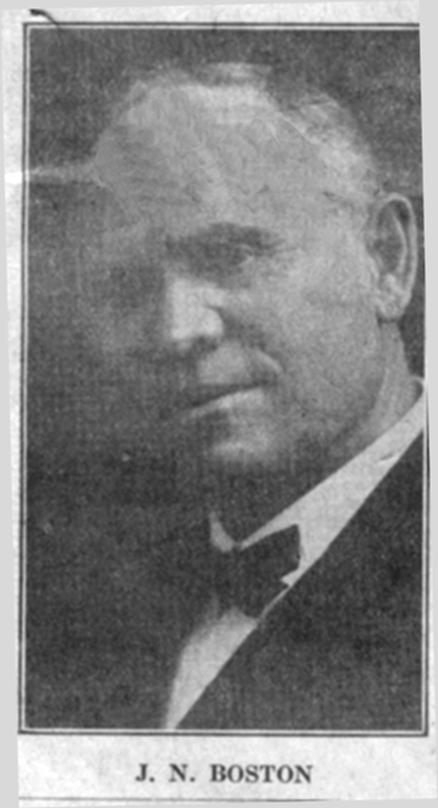
 Councilman J. N. Boston is not only interested in farming and is a fine agricultural business man but owns and operates the Boston Planing Mill, which supplies this section of the state with sash, doors, and lumber for anything built.  


Marion should feel proud and hopeful of the future prosperity of the city under the control of the new city officers all are businessmen of enterprise and energy.